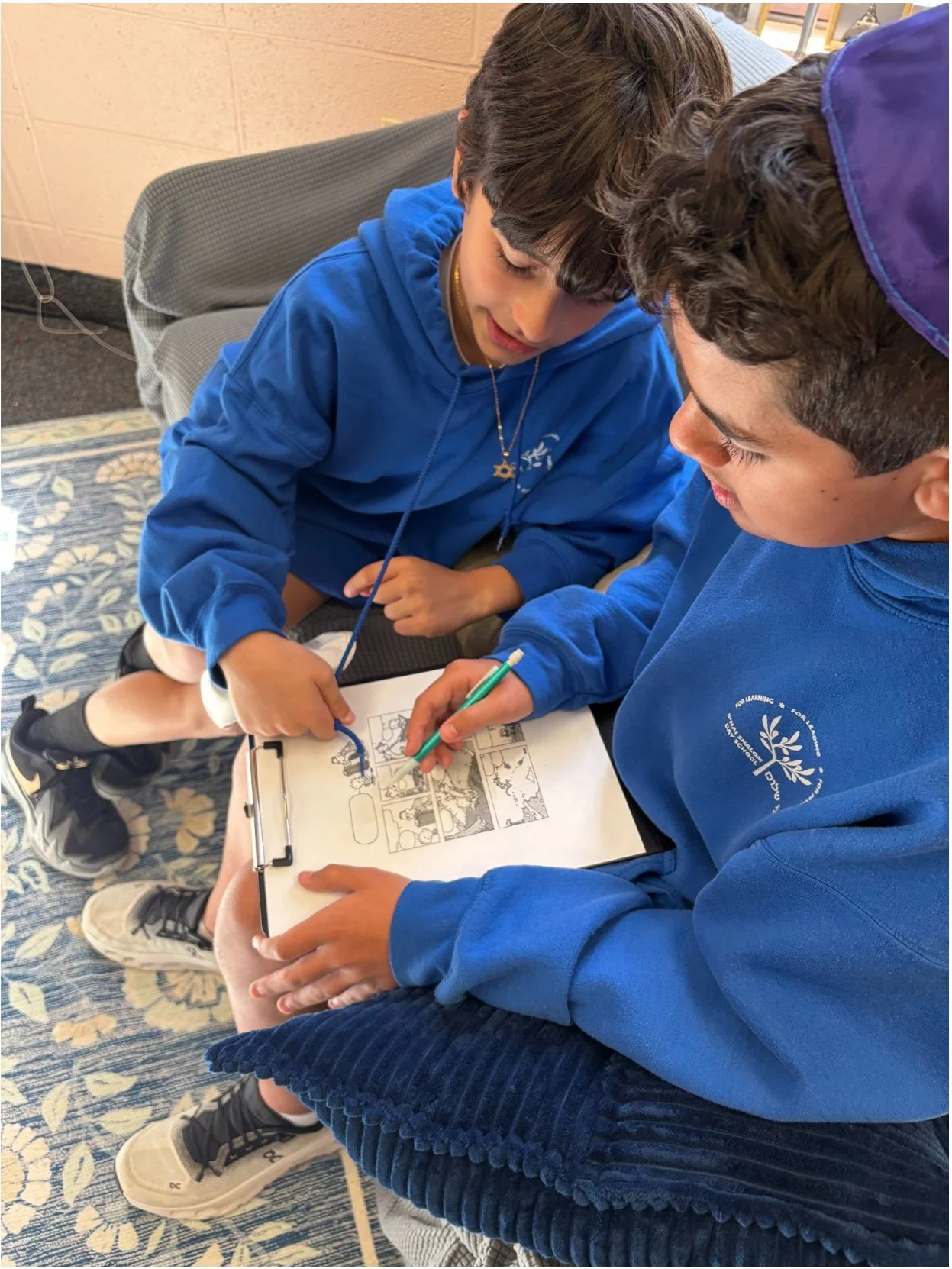
When Allison Cook (class of ’84) thinks back to her years at B’nai Shalom, she sees a strong connection between those early experiences and the work she does today. Allison is an educator who, together with her colleague Orit Kent, has developed Pedagogy of Partnership. When B’nai Shalom educator Ashley Eckstat introduced Pedagogy of Partnership to our school, Allison’s connection to B’nai Shalom came full circle. We were lucky to briefly talk with Allison and listen to her reflections on the evergreen connection she had with B’nai Shalom.
What are some of your favorite memories from your time at B’nai Shalom?
It is amazing for me to think about how formative those years were. I started B’nai Shalom when we moved to Greensboro in third grade. I was really only there from third through sixth grade, but the impact was just so fundamental to the person that I am and the work that I do.
I have all kinds of memories of some of the special kinds of rituals of the school. We did “Shabbat Surprise” on Fridays. My mom, Susan Cook, used to write an original Hanukkah play every single year, and it just felt like the entire school was involved with it in different ways. I remember the singing and the dancing. It was a small little gem of a school. It felt like every day was a little hug of a school.
I also remember specific teachers and what an impact they had on me. I really think I became an educator because of those teachers. Susan Zaleon z”l was an incredibly formative teacher for me, Cookie Cohen in Jewish Studies and CarolNeufeld, who was an incredibly creative teacher.
I remember as a young kid being really interested in pedagogy because I was always watching these teachers. I remember sitting in those classes and saying to myself, “That’s an interesting move that my teacher just made.” Or, “That’s an interesting way that this teacher explained something.”
Among the kids, we used to joke about how we could totally get Mrs. Cohen or Mrs. Zaleon off topic. And now I know as an educator that they weren’t letting us go off topic. They understood that those questions that we were raising were getting at things that were very important about the world and giving room for us to actually talk about things that mattered. I now, as an adult, look back on that and just laugh because we thought we were getting them off topic, but they actually knew what they were doing! And it made an impact.
Is there something you learned, experienced, or a person you met at B’nai Shalom that has stayed with you into adulthood?
I think growing up in Greensboro in general, we were a very tight-knit Jewish community. There was kind of an ethos of, if you want something to happen, you need to build it yourself. All of us got to do things and build things from a young age, which is how people learn and develop.
I truly think B’nai Shalom has produced a lot of Jewish professionals because we had to make it happen ourselves. We all had a role to play, and we learned a lot by doing.
I’m still very close with my friends from those families from that time. We’re scattered all over, but there’s a group of us who have a text message chain ourselves.
Can you tell us a little about your journey since graduating from B’nai Shalom? Where has life taken you?
After B’nai Shalom, I went to public school in Greensboro. Then, after Young Judaea Year Course, I went to the University of Michigan and moved to Boston straight from there, where I took a job as the assistant regional director of New England Young Judaea. I worked at camp for many years and just loved the idea of thinking about the intentional design choices that educators make in order to create the conditions for certain kinds of learning and community building to happen.
For me, it was a very straight line from these experiences I had as a young child at B’nai Shalom, learning and being interested in what these teachers were doing, all the way through to camp where we were consciously thinking about how we can we get the campers to interact with each other? How are we building community? How are we building friendships? How are we teaching Jewish and Israel content?
After Young Judaea, I had another formative role at a really special after-school Hebrew school program in Cambridge, Massachusetts, called Kesher, which became a national model for after-school childcare plus excellent Jewish and Hebrew language education.
It shared a lot of these B’nai Shalom-esque sensibilities. It was a communal, grassroots-y feel to it that was pluralistic in nature. It wasn’t a single denomination. It was, “We are here to learn and be a community together”.
From there I went to graduate school in education and also Jewish studies. Over grad school, I met my friend and colleague, Orit Kent, with whom I have developed Pedagogy of Partnership (PoP) over the last 20 years. PoP developed over time through educational research we did together and all kinds of work we did in the field, building out a philosophy of teaching and learning and a methodology for how to actually enact it and to teach teachers and school leaders how to do it.
What does it mean to you to know that, even as an adult, you’re still having an impact on B’nai Shalom and the students who come after you?
It’s so meaningful. I was so excited to see Ashley Eckstat at one of our workshops, and I’m so happy that my work can help strengthen B’nai Shalom in this virtuous cycle of learning.
I also feel incredibly grateful. A big part of my B’nai Shalom experience was shaped by my mother, who really made the school blossom in a way that I appreciate now as an adult and as an educator. What she did was full of creativity and spirit. She created experiences for students that were more three-dimensional than your typical classroom and school experience, with overlapping opportunities to strengthen learning and friendships and that allowed those seeds planted at B’nai Shalom to be sustained over time.
As a parent and an educator who works in many communities and schools across the country, I appreciate what a gift it is to be part of a community with such deep relationships and heart..
To use the Southern terminology, I feel blessed to still be part of the B’nai Shalom’s story.